Sitemap Generator UploadArticle.com Review: A Straightforward Tool for Getting Your Sitemap Done

_1783171113.jpg)
Sitemap Generator UploadArticle.com is built for a simple SEO job: create an XML sitemap from a website URL. It is not trying to be a full SEO suite, and that is exactly why people notice it. It gives website owners a quick way to produce a sitemap file without installing software, editing XML by hand, or depending on a developer.
The Bottom Line First
Sitemap Generator UploadArticle.com is best understood as a lightweight sitemap utility for small websites, blogs, basic business sites, and users who need a quick sitemap for Google Search Console. The tool’s main value is convenience. You enter a site URL, let the generator collect public URLs, and use the output as a sitemap file.
That sounds simple, but sitemap quality still matters. A sitemap should not include every page a crawler can find. It should include the pages that are public, indexable, canonical, and worth sending to search engines.
| Review Point | My Take |
| Main purpose | Generate an XML sitemap for a public website |
| Best user | Blogger, small business owner, beginner SEO user, freelancer |
| Best site type | Small or medium public websites with simple structure |
| Main benefit | Fast sitemap creation without coding |
| Main risk | Users may upload the file without checking URL quality |
| Not built for | Large ecommerce, news sites, enterprise SEO, complex JavaScript sites |
| Verdict | Useful for basic sitemap creation, limited for advanced SEO work |
Google describes a sitemap as a file that gives search engines information about pages, videos, files, and relationships on a site so crawlers can work more efficiently. That is the exact job this type of tool is meant to support.
What Sitemap Generator UploadArticle.com Actually Does
Sitemap Generator UploadArticle.com creates a structured sitemap file from a submitted website URL. In normal use, the user provides the homepage or domain, and the generator scans public internal pages that it can discover. The result is an XML sitemap that can be uploaded to the website and submitted to Google, Bing, or other search engines.
This makes the tool useful for people who understand that they need a sitemap but do not want to deal with technical formatting. XML sitemaps have a specific structure, and the Sitemap Protocol requires properly formatted XML tags and UTF-8 encoding. A generator removes that manual work.
The important distinction is that this is a generator, not a full diagnostic crawler. It can help you create a sitemap file. It should not be expected to audit the full technical health of your website.
Where UploadArticle Fits
UploadArticle.com is more commonly associated with article publishing, guest posting, and content distribution than with dedicated SEO software. That context matters. Sitemap Generator UploadArticle.com should be reviewed as a practical side utility, not as a direct replacement for tools like Screaming Frog, Sitebulb, Yoast, Rank Math, or XML-Sitemaps.com.
That is not a negative by itself. Many small website owners do not need a full SEO crawler just to generate one sitemap. They need a quick file that can be checked and submitted.
The tool sits in this middle space:
| Tool Category | Example User | Fit |
| Manual XML writing | Developer or technical SEO | Too much work for beginners |
| Simple online generator | Blogger or small site owner | UploadArticle fits here |
| WordPress sitemap plugin | WordPress publisher | Better for ongoing updates |
| Technical SEO crawler | SEO professional | Better for audits and large sites |
| Enterprise crawler | Large platform or ecommerce brand | Overkill for small websites |
So the right question is not “Can this replace a professional SEO crawler?” It cannot. The better question is “Can it help a normal website owner create a usable sitemap quickly?” For basic websites, yes.
How the Workflow Feels
The workflow is direct and beginner-friendly. A sitemap generator should not make users think too much. It should ask for a URL, scan the public site, and produce a usable output.
A proper workflow looks like this:
| Stage | What Happens | What to Watch |
| Start with the correct URL | Use the preferred homepage version | Avoid mixing HTTP, HTTPS, www, and non-www versions |
| Generate the sitemap | The tool scans public internal pages | Pages not linked internally may be missed |
| Review discovered URLs | Check what the tool found | Remove weak, duplicate, private, or irrelevant URLs |
| Export the file | Save the XML sitemap | Keep the file name clean, usually sitemap.xml |
| Upload to site root | Place it where crawlers can access it | Example: https://example.com/sitemap.xml |
| Submit in Search Console | Add the sitemap under the Sitemaps report | Google can show processing errors and access history |
| Maintain it | Regenerate after major site changes | Static sitemaps become outdated if the site grows |
Google allows sitemap submission through Search Console, the Search Console API, or a sitemap line inside the robots.txt file. Search Console is useful because it shows whether Google accessed the sitemap and whether there were processing errors.
The tool handles the first part of the job. The website owner still has to handle quality control and submission.
What the Output Means
The output is an XML sitemap file. Instead of publishing raw XML code inside the article, it is better to show this part visually with a small screenshot-style graphic. That keeps the review readable while still helping beginners understand what the file contains.
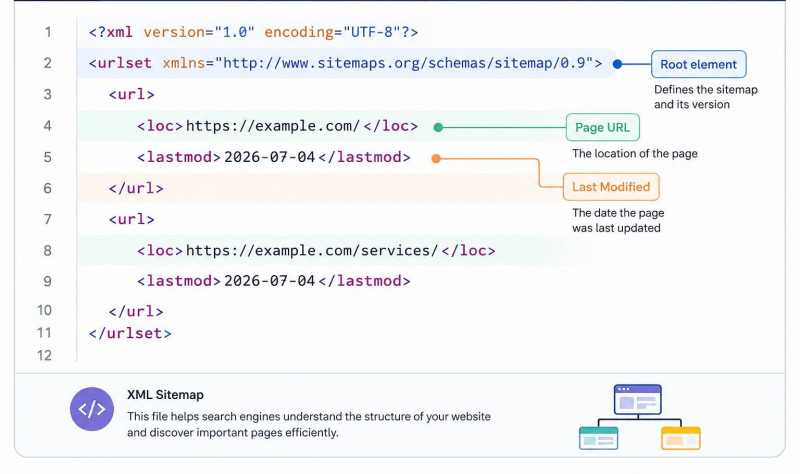
A sample XML sitemap showing two public URLs and their last modified dates.
The sitemap file usually includes the page URL and may include optional fields such as last modified date, change frequency, and priority. The core field is the URL itself. If the URLs are wrong, the sitemap is weak no matter how clean the XML looks.
A single sitemap also has size limits. Google says a sitemap file must not exceed 50 MB uncompressed and must not contain more than 50,000 URLs. Larger websites need multiple sitemap files or a sitemap index.
That limit tells you where this type of tool fits. It is fine for small and medium sites. It is not ideal for huge catalogs, large directories, news publishers, or ecommerce stores with changing inventory.
The Feature Set
Sitemap Generator UploadArticle.com is not impressive because it has dozens of features. It is useful because it focuses on the one task most beginners need.
The practical features are:
It lets users create an XML sitemap without writing code or understanding XML syntax.
It works through the browser, so there is no desktop software to install.
It starts from a public website URL and attempts to discover internal pages.
It produces an output that can be uploaded to the website and submitted to search engines.
It is suitable for quick sitemap creation when the site structure is simple.
It gives non-technical users a way to complete a basic SEO setup step independently.
That is enough for basic use. The gap appears when users need deeper control.
A more advanced sitemap system would let users filter URLs by status code, canonical status, robots rules, noindex tags, content type, template type, language version, media type, or crawl depth. A basic generator usually does not provide that level of control.
Sitemap Quality Is the Real Test
A sitemap generator should not be judged only by whether it creates a file. The better test is whether the file is worth submitting.
A good sitemap should contain pages that search engines can access and that the site owner wants indexed. It should avoid junk URLs, broken URLs, redirects, duplicates, and internal pages that do not belong in search results.
| What to Check | Why It Matters |
| 200-status pages | Broken pages do not belong in a sitemap |
| Preferred domain version | Mixing www and non-www can create inconsistency |
| HTTPS URLs | The sitemap should use the secure final version of each page |
| Canonical URLs | The sitemap should include the page version you want indexed |
| Noindex pages | Pages blocked from indexing should usually be excluded |
| Redirect URLs | Submit the final destination, not the old redirected URL |
| Duplicate parameters | Tracking or filter URLs can pollute the sitemap |
| Thin archives | Weak tag or search pages can reduce sitemap quality |
Google recommends using absolute URLs and choosing preferred canonical URLs when creating a sitemap. That is a key point many beginners miss.
This is also where UploadArticle’s sitemap generator should be used with judgment. The tool can produce the file, but it cannot replace an SEO person’s decision about which URLs deserve to be in that file.
What It Can Actually Do for SEO
The biggest misconception about sitemap tools is that they improve rankings directly. They do not.
A sitemap helps with discovery. It gives search engines a structured list of URLs. That is useful for new sites, large sites, recently updated sites, and pages that are not well connected through internal links. But a sitemap does not make a weak page stronger. It does not build backlinks. It does not fix thin content. It does not force Google to index a page.
The practical SEO value looks like this:
| Helps With | Does Not Help With |
| Faster URL discovery | Guaranteed indexing |
| Better crawl organization | Ranking improvement by itself |
| Search Console submission | Content quality issues |
| New website setup | Backlink authority |
| Basic technical hygiene | Duplicate content strategy |
| Finding obvious URL gaps | Full technical audits |
This is why Sitemap Generator UploadArticle.com is helpful but limited. It supports a basic SEO task. It does not become an SEO strategy on its own.
Pricing and Access
The tool is a commonly free, browser-based sitemap generator. It is positioned as a quick XML sitemap tool for users who do not want to deal with plugins or code.
The pricing weakness is not cost. The weakness is documentation. Dedicated sitemap tools usually explain their crawl limits, page caps, update features, paid tiers, export options, and storage policies clearly. UploadArticle’s sitemap generator appears more like a simple utility, so users should not expect the same level of product documentation as a full SEO platform.
For context, XML-Sitemaps.com offers free sitemap generation up to 500 pages and also provides paid options for users who need larger or more advanced sitemap handling.
That comparison makes UploadArticle’s position clearer. It is best for quick, low-friction use. It is not built around an advanced subscription model or professional SEO dashboard.
Privacy and Security
For a public website, using a sitemap generator is usually low-risk. The submitted URL is already available online. But that does not mean every URL should be entered into a public tool.
Do not use a basic public sitemap generator for:
Private staging websites that are not ready for public access.
Client preview URLs with private tokens.
Admin panels, login pages, dashboards, or internal tools.
Unpublished project folders.
Campaign URLs that reveal sensitive tracking structures.
Websites under NDA or not yet launched.
The safer rule is simple: only submit pages that you are comfortable letting a third-party crawler access.
This is especially important for agencies. A small business owner using the tool on their public site is a normal use case. An SEO agency using it on a confidential staging build should be more careful.
Best Use Cases
Sitemap Generator UploadArticle.com works best when the site is small enough to review manually after generation.
| Best Use Case | Why It Fits |
| New blog | Helps create a basic sitemap before Search Console submission |
| Small business website | Good for service pages, contact pages, and simple navigation |
| Static HTML website | Useful when no CMS-generated sitemap exists |
| Beginner SEO setup | Gives users a practical first step |
| Freelance client onboarding | Useful for quick basic sitemap creation |
| Small content site | Works when the structure is clean and not too large |
A simple five-page website, a small blog, a personal portfolio, or a local business site is the ideal environment for this tool. The output is easy to check, and the sitemap can be submitted quickly.
When It Is the Wrong Tool
The tool becomes less useful when the website changes often or has technical complexity.
Avoid relying on it as your main sitemap solution if:
The website publishes new articles every day.
The site has thousands of product pages.
The site uses complex filters, parameters, or faceted navigation.
The site depends heavily on JavaScript rendering.
The business needs image, video, or news sitemaps.
The site has multiple languages and hreflang requirements.
The SEO team needs crawl reports, status codes, and canonical checks.
The sitemap must update automatically whenever content changes.
In those cases, a CMS plugin, server-generated sitemap, or professional crawler is a better choice.
Competitors and Better Alternatives
Sitemap Generator UploadArticle.com competes mainly with simple online sitemap generators. It does not seriously compete with full SEO crawlers.
| Tool | Best For | Why Choose It |
| XML-Sitemaps.com | Small sites needing quick sitemap generation | Clear free limit and established sitemap workflow |
| SEOptimer Sitemap Generator | Manual sitemap generation | Lets users enter pages and generate XML output easily |
| MySitemapGenerator | Online sitemap generation | Offers free online sitemap generation for multiple search engines |
| Octopus.do | Visual sitemap planning | Good for visualizing structure and creating XML sitemaps |
| PowerMapper | Visual, HTML, and XML sitemaps | Builds different sitemap formats for search engines, users, and development teams |
| Yoast SEO | WordPress sites | Better for automatic ongoing sitemap management |
| Rank Math | WordPress SEO control | Better when sitemap settings need to be managed inside WordPress |
| Screaming Frog | Technical SEO professionals | Better for crawling, auditing, and exporting controlled sitemap files |
The right choice depends on the site. UploadArticle’s sitemap generator is fine for basic sitemap creation. WordPress users should usually prefer a plugin. SEO professionals should use a crawler. Large websites should rely on dynamic sitemap generation.
What I Would Check Before Publishing the Sitemap
A careful user should treat the generated sitemap as a draft, not a finished file. Before uploading it, check:
Whether the homepage, service pages, blog posts, and important landing pages are included.
Whether test pages, search pages, login pages, or thin tag archives are included by mistake.
Whether all URLs use HTTPS.
Whether the domain version is consistent.
Whether any redirected or broken URLs appear.
Whether any important pages are missing because they are not internally linked.
Whether the sitemap opens correctly in a browser.
Whether Google Search Console accepts it without errors.
This is the difference between simply generating a sitemap and using a sitemap properly.
Final Verdict
Sitemap Generator UploadArticle.com is a useful tool for a narrow but important job. It helps users create an XML sitemap quickly without coding, installing software, or setting up a plugin. That makes it a good fit for small websites, beginner bloggers, static sites, and simple business websites.
Its strength is speed and simplicity. Its weakness is depth. It does not replace a technical SEO crawler, an automatic CMS sitemap, or a proper audit process. Users still need to review the output, remove weak URLs, upload the sitemap correctly, and submit it through Search Console.
The verdict is clear: use Sitemap Generator UploadArticle.com when you need a quick sitemap for a small public website. Skip it when the website is large, fast-changing, technically complex, private, ecommerce-based, or dependent on advanced SEO controls. It is a practical sitemap generator, not a full SEO system.



Trending Collections









Popular Tags

Plus Size Work Outfits
32 Posts
School Outfit
280 Posts
Denim Outfits
562 Posts